Sunday, February 5, 2017

W is for Whitehaven

W is for Whitehaven (click here for map.) A two hour drive along Maryland’s scenic Blue Crab Byway brought me to the oldest town located on the Wicomico River. Whitehaven is much more than charming - the town boasts something older than the State of Maryland. 
Additionally, this “something” is believed to be the oldest in the nation.  Today, I had the opportunity to step back in time and personally experience this “something”, which I will happily talk about later. 

The quaint, unincorporated town of Whitehaven is located in Wicomico County and has a population smaller than the roster of an NFL football team (42 residents,) a total land area of 0.37 square miles, and 0.36 square miles of water.  All but two of the 27 dwellings were constructed prior to the 20th century!  
Old Home in Whitehaven
Restoration is continuing on the oldest of the structures.  Initially, the town was developed as a land transportation hub.  Later, after the Wicomico River was dredged, the area became an official port.  Both the deep water location of the town and the presence of several roads made it an ideal location for a town.

The entire village has been placed on the National Register of Historic Places.  The one historical marker in town reads: 

“Ferry operated here as early as 1692. Settlers were led by Col. George Gale of Whitehaven in the North of England. His first wife, Mildred Warner Washington who by previous marriage was George Washington's grandmother, lived nearby before her death in 1701. 'Whitehaven Company' of Somerset County Militia fought with the Maryland Line in Revolutionary War.”

Was Whitehaven, Maryland named after the town of Whitehaven in England?  It looks as if it was.  Research told me Col. George Gale remarried Elizabeth Denwood at Whitehaven, Cumbria, England in 1701.  In 1702, George and Elizabeth moved to America and founded a small settlement in Kent County, Maryland and called it Whitehaven (now in Wicomico County.)
I arrived to the town early ready to explore!  I quickly found I could only travel the one main road, which formed a ¼ mile loop through the Whitehaven Historical District.  Additionally, there were three small streets bisecting that loop.  Structures included the homes mentioned above, a church, a historical schoolhouse, 
Whitehaven Schoolhouse
and a marine railway.  However, there wasn’t any commerce – no gas station, no general store, not even a bank.  There was a restaurant (The Red Roost), but it was closed for the season.  I panicked – what about lunch?!  Oh, no!  Readers, I cannot tell a lie - I already knew what I was up against because I did my research.  I am giving you fair warning - if you decide to visit Whitehaven, be sure to pack a lunch!


The first item of interest was the Whitehaven Schoolhouse.  The Whitehaven Schoolhouse opened in 1886 as a grammar school.  It originated as a one-room schoolhouse (it was later expanded) and has significance as it is one of the few remaining in Wicomico County still located on its original site.  Prior to the construction of the schoolhouse, Whitehaven was served by schools roughly three miles away.  As the population of the village grew, it was evident a schoolhouse was necessary. 
Whitehaven Schoolhouse
In 1886, the present schoolhouse lot was sold for $1.00 to the County Commissioners.  The first room of the schoolhouse was built soon afterward and children in grades 1 through 7 were taught.  In 1908, the second room of the schoolhouse and a porch across the older section were built.  Children in grades 7 through 9 were taught in this addition.  In 1935, the little schoolhouse closed when students began to be bused from Whitehaven to the nearby village of Quantico.  In 1937, the Whitehaven Methodist Church acquired the schoolhouse and began using it for various social events such as church suppers and ice cream socials.  Sunday school classes were also taught here.  In 1975, it was refurbished and maintained as a “Country Store” and gift shop.  Those days were short lived as it was used as storage space several years later.


In 1991, the little schoolhouse once again gained importance in the community of Whitehaven as it earned its new title of Community and Church Hall.  In this capacity, the schoolhouse serves as a meeting place for the Whitehaven Historical Society, as an exhibition space for local artists, and as a repository for archived documents and photographs relating to Whitehaven’s history.  

Just beyond the schoolhouse stands the Whitehaven Methodist Episcopal Church.  Built in 1892, it stands as an unusual expression of Whitehaven’s maritime and boat building heritage.  
Whitehaven Church
In fact, according to the description of the church in the Maryland Comprehensive Historic Preservation Plan Data:


“The most remarkable aspect of this church interior is the paneling which sheathes its walls and ceilings.  This paneling consists of diagonally placed strips of heart pine which creates a herringbone pattern against the [wall] and [ceiling].  Although the craftsman of this interior is unknown, the church is said this reflects the work of local shipbuilders who have long made their home in Whitehaven.” 

There are two interesting facts about this church.  
Whitehaven Church
First, the interior can be read as an archive of Whitehaven.  This is because throughout the years, inscribed memorials of deceased family members were donated by members of the congregation.  These memorials include:  art glass windows, the bible, a picture of Christ,
chancel cross, and an organ. 


What is the second interesting fact?  Religious services are only held four times a year.  Additionally, the church is available for special events, such as weddings and funerals.

I left the church in hopes of finding the next item on my “To See” list.  I read the town was home to a marine railway, but I was unsure of what I was looking for.  Was it a building?  A set of train tracks?   Whatever it was, I was hoping it was not on someone’s personal property because most of the town had “No Trespassing” signs affixed to posts around driveways and piers.   

Random boat on Wicomico River - not built by Shipyard!
According to this link, Shipbuilding had been a part of the economy of Whitehaven since the early 19th century.  The marine railway was built as part of the operation.  The earliest evidence documented suggested there was large-scale shipbuilding in Whitehaven in 1808.  19th century shipbuilding in Whitehaven morphed into ship repair during the early 20th century.  The types of vessels repaired at the shipyard represented a wide cross section of the types of boats operating on the Wicomico River and throughout the Eastern Shore.  They included bugeyes, schooners, scows, skiffs, launches, bateau, flattie, canoes, yachts, pungy, and skipjacks.  Shipyard operations in Whitehaven ceased in the 1970s as the Whitehaven Shipyard moved to another location. 

I rounded one of the bends for what seemed like the 20th time, 
Marine Railway
and off in the distance was a house with some VERY large cogs attached to its backside.  Could this be the marine railway?  There was not a “No Trespassing” sign in sight, so I ventured over to the area.  As I approached the house, I was able to see the cogs up close.  They were enormous!  The house was of 20th century design, which was unlike the other homes in town.  Extending off the cogs was an elevated single slipway leading to the edge of the shoreline, but not into the water.  
Marine Railway
I did not see any metal track or rails inside of the walls – the area was filled in with grass/weeds.  I assumed this was the railway, but nothing told me I was correct.  I really needed to find someone to ask.
 

Whitehaven has been host to “ships passing in the night” – literally.  One of these ships was the famed Chinese junk ship - the Mon Lei, which sailed through Whitehaven on its way to nearby Salisbury one evening in June 1942.  Over a three year period, the “floating museum” equipped with 800 square feet of canvas reinforced by bamboo bracings traveled thousands of miles from China visiting numerous American ports.  Stories about the ship’s origins vary.  Some accounts reported the Mon Lei was built as early as 1890 while others claim it was built in 1939 by a wealthy Hong Kong businessman.  It is also not clear when and how the famous “Believe it or not” Robert Ripley bought the ship in Baltimore.  Ripley had become taken with the exotic ship and invested significantly in his prized possession.

You are probably wondering when I will be visiting the “something” older than the nation.  All in good time, good readers….all in good time…….

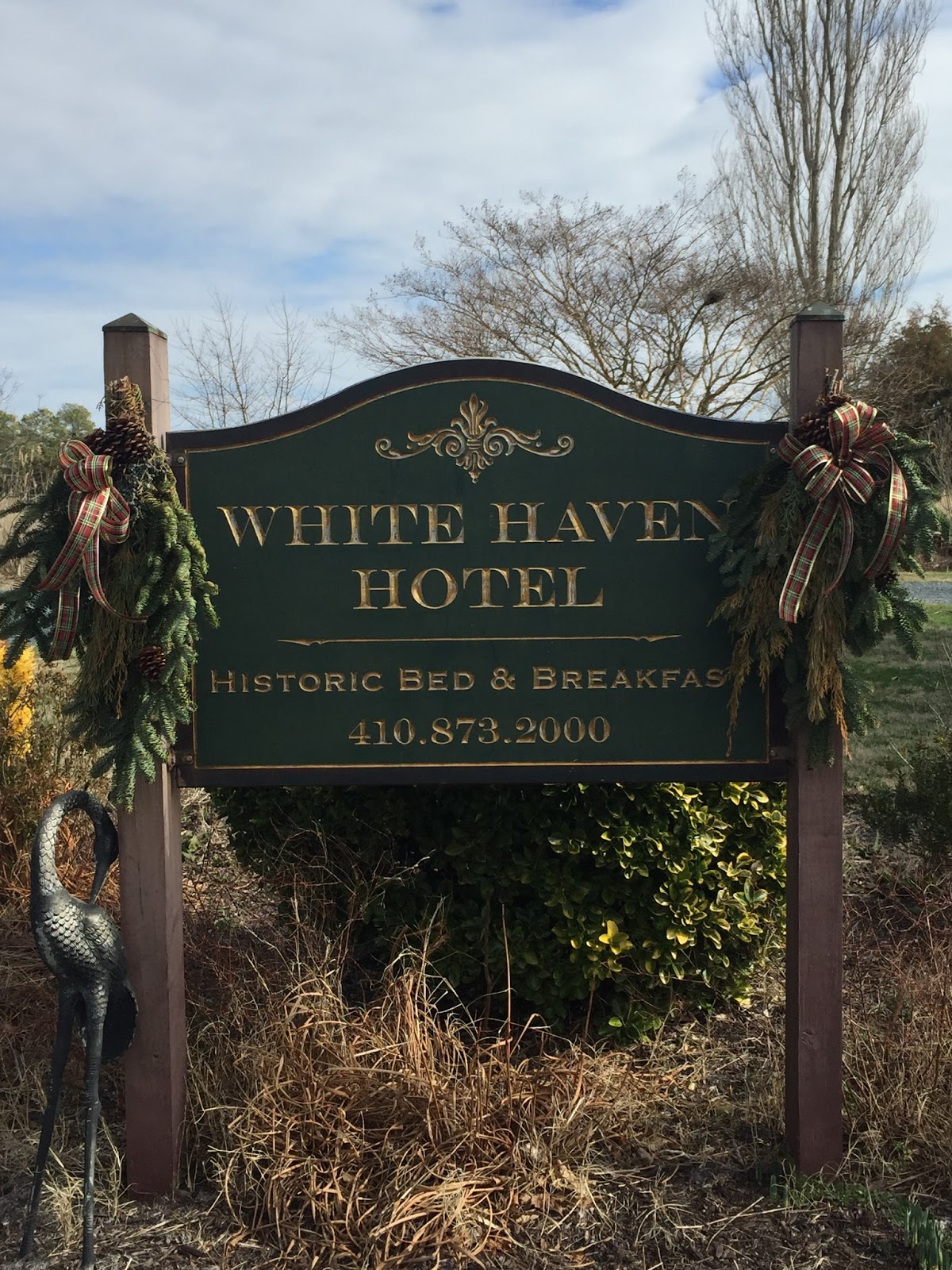
From what I assumed was the marine railway, I wandered over to the Whitehaven Hotel.  The Whitehaven Hotel is an 8-bedroom Bed and Breakfast.Built in 1810, The Whitehaven Hotel was first constructed as a two and a half story road-house or private home.  In the late 1800s, the Village of
Whitehaven was a vibrant riverfront community with shipyards, a canning factory, a new school and church, and several stores.  To meet the region’s burgeoning demand for lodging, the building went through its first major expansion in approximately 1877 and opened as a hotel.

The Whitehaven Hotel was also known as a “Drummer’s Hotel.”   The Hotel accommodated travelers during Whitehaven’s boom years (the 1880s through the 1920s) when the town was a stopping point for people traveling between Vienna and Princess Anne.  The Hotel also provided overnight stay for visitors who had booked passage on steamships to Baltimore.  Many of the Hotel’s guests were “drummers” - salesmen from Baltimore who would try to “drum” up business by selling household goods that ranged from soap powder to mattress ticking.  Drummers would pay a quarter a night and sleep four to a bed.  However, during the 1940s, engineers dredged the Wicomico all the way up to Salisbury (a town located about 20 miles northeast of Whitehaven.)  The ships bypassed the town, local canneries closed, and Whitehaven seemingly stopped in time. 
Front View - Whitehaven Hotel
World War I provided a boost to Whitehaven’s shipyards, but river traffic and commerce eventually shifted to Salisbury. During prohibition, the "Whippoorwill Gang" was said to operate nearby.  A secret door in the Hotel store is thought to have been used for passing liquor to customers who had first been given the once-over.  As the village’s fortunes declined, the Hotel became a private residence and closed shortly after World War II.

In 1995, the Hotel was saved from the wrecking ball through the cooperative efforts of local residents, the Maryland Historic trust and by those captivated by its charming location.  In 1997, restoration began to reverse nearly 50 years of neglect and bring this jewel of the Eastern Shore back to its stately appearance.  It remains in its original form as one of the last buildings in a long-gone network of points between steamship routes connecting small waterfront towns and islands in the Chesapeake Bay to commercial ports as far away as Baltimore.
Side View - Whitehaven Hotel
When I reached the Whitehaven Hotel, I was immediately captivated.  The Hotel was located on the banks of the Wicomico River at the end of a road and it had the most amazing view of the river and surrounding marsh.  The grounds of the Hotel were so peaceful I felt instantly relaxed.  The front porch was generous and I could imagine myself just sitting in one of the rocking chairs viewing a wonderful sunset and native birds and waterfowl.  The ambiance of the Hotel’s interior must have been as equally incredible!  I was really excited about visiting this place as the reviews written by people who stayed here were nothing short of stellar.

Looking around the parking lot, I became concerned as there was only one vehicle visible and it was a maintenance vehicle.  I tried the door handle on the Hotel, but it was locked.  I called the contact numbers provided on a sign on the door, but could only leave a message.  Disappointed, I decided to move on.
My last stop on the “To See” list was what you have been patiently waiting for – my experience on the nation’s oldest “something.”  Just what was this “something?”  Well, it was the Whitehaven Ferry.

My experience began as I approached the ferry operator (Captain Bobby Bean) and asked if I could just sit and talk to him as he worked.  He happily nodded.  I took a ride into history as I crossed the Wicomico River on this car ferry.  I did not want to take up room on the ferry with my car, so I parked and walked on the ferry. 

The first ferry began operating in 1688 and is thought to be the oldest continuously operating ferry in the United States.  The ferry is docked in Wicomico County and can carry up to 3 cars and 6 people.  The cable ferry journeys 900 feet across the Wicomico River ending up on the other side in Somerset County.   
Ferry's Cable
The ferry ride is free and takes 4-5 minutes per crossing.  To get to the same location by car, it would take 40-45 minutes.  Each county pays half of the expense to keep the ferry operating.
 

Bobby told me he is one of only two full-time operators.  He has been captaining the ferry for 26 years.  What did I find to be the most interesting fact about this particular job?  Not only is the job older than the State of Maryland (7th State to ratify the U.S. Constitution in 1788), the job is older than Wicomico County (created from Somerset County and Worcester County in 1867) AND the job is older than the United States (founded in 1776.)
Cable Mechanism
I stood in Bobby’s little cab for about 1 ½ hours talking with him.  Remember I mentioned it took only 4-5 minutes per crossing?  I can’t tell you how many times I crossed the river in that 1 ½ hours, but Bobby makes close to 150 crossings per day.  Bobby explained to me how the cable worked and  showed me the mirrors forward and aft so people who ride the ferry know how far to pull up so three vehicles can fit on board.  Bobby knew the regular passengers – who is going to work and who is coming home from work.   He pointed out the ones who are not regular passengers (like me) because he doesn’t recognize the cars.  Bobby told me there is a ferry hotline, but most do not use it (I did before I drove to Whitehaven.)  The hotline offers information on ferry closures due to weather, tide, repairs, or other reasons.  He says people tend to get mad if the ferry isn’t open, which makes Bobby wonder why they don’t use the hotline more often. 

Lines for the ferry form at a stop sign in front of the Whitehaven Hotel. 
Ferry
Sometimes there’s a line of cars waiting for the ferry, and since only three vehicles can fit and a maximum of six passengers are allowed to ride at one time, that involves waiting for more than one trip.  Those who want to ride the ferry must expect the possibility of encountering a line and plan to arrive before the last trip.  If the “Ferry Closed” sign hangs across the ferry, latecomers have no choice but to drive around the river.  When the ferry’s closed, it’s closed.  Bobby quotes one passenger as saying, “The ferry is a gift, not a given.”
 

During my many trips across the river, I asked Bobby if the house with the cogs attached was the marine railway.  He nodded.  He asked if I had been to the Hotel yet.  I told him I was there before I got on the ferry, but nobody answered my knocks or my calls. 
Ferry
He immediately got on the phone and called Cindy, the Innkeeper.  She answered and told him she was in town buying food for the guests arriving later that evening and wouldn’t be back for a couple of hours.  I thanked Bobby for making the call and decided I would have to visit Cindy at a later date.
 

I made the decision to finally ditch my sea legs and head home.  Riding the ferry was definitely an experience to remember.  As I disembarked the ferry, I thanked Bobby for his time and for keeping history alive.  He smiled and told me never before had he heard anyone put his job in that perspective. 

Aside from the fact I could not eat lunch in the town, I found Whitehaven to be extremely enchanting.  I became smitten with this small town based on its unique history and serene views.  Without a doubt, I could easily come back to relax and “get my chill on.” 
View from Behind Hotel


Saturday, December 31, 2016

V is for Vienna

V is for Vienna (click here for map.) An hour long drive along Maryland’s Eastern Shore brought me to the “Gateway to the Nanticoke” – Vienna’s nickname. Vienna boasts a rich history stemming back over 300 years complete with a
tight-knit community dedicated to preserving its past. Exploring yesteryear in Vienna was going to be an absolute pleasure!

Located in Dorchester County, Vienna was founded in 1706 and was later incorporated in 1833. The town has 271 residents, a land area of 0.19 square miles, and 0.0 square miles of water. In his book, “A Walking Tour of Vienna, Maryland (Look Up, America!), Doug Gelbert provides a summary of Vienna’s history, which reads:

“Rich in tradition and history, this region was first mentioned by Captain John Smith in his journals during his exploration of the Nanticoke River in 1608. This tract of land was a portion of ten thousand acres along the north shore of the Nanticoke River granted by Charles Calvert to Lord Baltimore. The entire tract was patented in 1664 as Nanticoke Manor. In 1671, the Colonial Assembly recommended this point as a ferry crossing. 


The village on the western bank of the Nanticoke River in southeastern Dorchester County was known simply as “the town on the Nanticoke River” until being decreed by the Colonial Assembly as Vienna on July 11, 1706. The town thrived as a port capable of handling large ships carrying goods from England, and then also as a trade center when a tobacco warehouse was built in 1762.
Nanticoke River
Vienna was the site of the first shipyard on the Nanticoke River.

Its importance to commerce and trade was evident when it was attacked by British vessels at least five times during the Revolutionary War, taking ships and provisions. The only Revolutionary military casualty on Dorchester soil, Levin Dorsey, died on these shores, hit by a shot fired from a British vessel. In the War of 1812, Vienna was again attacked by British forces.”

The week prior to my visit, I contacted the Vienna Town Hall to inquire about any tours available. A very nice woman told me the only thing offered was the self-guided walking tour and I was given the link to the town’s map. Then she told me about the annual event I probably did not want to miss. The Saturday after my planned visit, Vienna’s 36th Annual Luminary Event would take place and I may want to consider moving my visit to that weekend.

She told me the entire town would be aglow with 1,500 luminaries lining the streets!
First Brick Home in Vienna
Vienna’s notable homes would be available to tour with an admissions ticket, churches would have entertainment and tours free of charge, and the many historical buildings would offer similar education. Additionally, many of Vienna’s residents would be opening their homes to visitors during the event. Some of these homes were built as early as the 1700s. If walking is a problem, there is an available tram to transport you to and from the various interest points. And the best part of this celebration? Children can visit with Santa and his helpers at the historical Toll Collector’s House.

Although tempting, unfortunately I had to keep my promise to other holiday commitments. I was extremely disappointed I wasn’t going, to say the least.


On the day of my visit, I arrived with my self-guided walking map in hand eagerly wanting to learn as much about Vienna as possible. I quickly found myself completely overwhelmed - simply driving around the streets made me feel immediately immersed in the town’s past. In addition to learning about the history of Vienna, I was hoping to locate the area where something of historical significance was discovered roughly 1 ½ years ago. What was found? Ha! We can talk about that later…


The first item I discovered was actually posted behind the “Welcome to Vienna” sign.
 
It was a historical marker for Unnacokossimmon – the Emperor to the Nanticoke Native Americans.He lived at the ancient Indian village, Chicone, located in the north part of Vienna, and was the ruler of the region in 1677. The Chicone Village was something on my “To See” list. Research told me I would be able to see the first authentic replica of a single family Native American homestead built using materials and techniques available to prehistoric people, circa pre-1600.

The Chicone Village is located on property it shares with the Handsell house
Handsell House
– the name of the house and of the property. Handsell derives its name from the original land grant laid out in 1665 and is named for the term "handsell" which means "honest money”, which reflects on the area's function as a trading post with Native Americans.
Handsell is historically and permanently linked to the early Native Americans of the Nanticoke and Chicone tribes. This site was established as an Indian Reservation by the State of Maryland in 1720, but in 1768 the Maryland legislature passed a bill authorizing the purchase of all remaining rights to Chicone Native American lands from the Nanticoke Native Americans.
Chicone Creek
According to Handsell’s history:


“[Handsell’s] first patent was awarded to Thomas Taylor, at Chicone who formerly was a licensed “Indian trader” and then a high ranking military officer who was usually the person sent by the proprietor to deal with the Nanticoke “Emperor” during this period. 
On July 13, 1665 he received a land grant called “Handsell” for 700 acres, which encompassed the main Native American residential sites within the Chicone town lands. It is likely these were friendly patents held by Taylor to protect the “Indian towns” from other Englishmen.”

Shortly after crossing the serene Chicone creek, I arrived at the Handsell House.
Longhouse, Handsell House, & Wattle Fence
The house is currently being restored and is not open to the public. Nevertheless, I was able to get a view of the Chicone Village on my own. The Chicone longhouse was impressive and nothing like I had ever seen before! From what I understand, it took volunteers roughly 2,500 hours to complete this thatch and reed home built from material harvested from county fields and forests. Located along side of the longhouse was a wattle fence garden, which is planted every summer with plants appropriate to a garden of the Chicone people. I was able to look at a completed lean-to work shelter, as well.  There is also a nature trail at Handsell with a sign posted at the trailhead reading,“Walk the Footsteps of the Native People of Chicone and Find These Trees.”
View Inside Longhouse
This certainly sounds like a challenge I would be willing to accept!

There are a couple of special events held every year at Handsell. The first is in April – Chicone Village Day. On this day, the public can witness life of the Chicone Village through the eyes of a costumed interpreter along with other Native American representatives from the Delmarva Native tribes.
There are demonstrations of cooking, gardening, and artifact displays from the excavations at Handsell in addition to sampling Native inspired food.

The second special event is usually held in October - the Nanticoke River Jamboree. It features performers and historical re-enactors, demonstrations, traditional 18th and 19th-century crafts, musical entertainment, food and refreshments.
Chicone Village Lean-To
There is usually a theme of the Jamboree and it varies every year. For instance, in 2015, the theme was “Fire.” So, the Jamboree’s focus was on how fire was necessary to sustain the very existence of both the Native Americans and colonists. Besides cooking, many skills necessary to life required the use of fire, such as: brick making, blacksmithing, tanning, and dying wool. Additionally, like other homes from the early centuries, the Handsell house experienced fire, so the colonists were constantly aware of how fire negatively impacted their lives.

Fun and educational events are right up my alley. I definitely see a couple of road trips in my future.

From Handsell, I drove back into downtown Vienna and continued with my self-guided walking tour. I quickly discovered a majority of the historical homes are now owned and occupied as private residences. None of the other historical buildings were open for tour this weekend.

My next stop was the Vienna Heritage Museum, which originally opened in 1923 as a service station with a soda fountain.
Service Station Marker
I could not ascertain the year in which the service station closed, but in 2001 it opened as a museum. Inside there is a cannonball, Victorian clothing, Native American artifacts, and other remembrances of the town’s past. Items like these prove very interesting because I gain insight into how things once were. Additionally, what I really wanted to see was the display of original machinery from the last remaining mother-of-pearl button factory in the United States – the Martinek Button Factory. Once located on Elliot Island, Maryland (about 31 miles south of Vienna) the factory closed in 1999.  Sequins were also made at this factory, which leads me to another very interesting tidbit of information.
Vienna Heritage Museum
If you are ever touring a place where Elvis Presley’s costumes are showcased, look very closely at the sequins. Those are Martinek sequins. And who wore the last of the Martinek sequins? Barbie (as in Barbie doll)!

Next on my list was the Ferry Tollkeeper’s House. According to the guide, the house was built in 1860 and served as the base of operation and collection of fares for ferry service that was established by decree of the Colonial Assembly in 1756.
Ferry Tollkeeper's House
It is believed that this building was used until 1931 when the ferry service was replaced by a bridge. At some point, the house was relocated from the present-day boat ramp to one of the side streets in town.

From the Tollkeeper’s House, I wandered over to Water Street. Water Street runs along Vienna’s waterfront park known as “Emperor’s Landing” in honor of the Nanticoke Native Americans who once lived there. Descendants believe that Emperor’s Landing was used as a ceremonial feasting ground.
Emperor's Landing
This area is also one of the areas Captain John Smith explored. In December 2006, the U.S. Congress designated the routes of Smith’s explorations of the Chesapeake as a national historic trail—the first national water trail!

All the while, I had been looking for the location of that discovery I mentioned earlier and do you know what? I found it! The location was to the right of one of the concrete pilings supporting the Nanticoke Memorial Bridge. So, just what was this discovery?

According to an amazing article written for The Baltimore Sun on 31 August 2015:
 

“While clearing debris under the Nanticoke Memorial Bridge in Vienna, State Highway Administration workers uncovered one of the oldest Maryland-built shipwrecks ever discovered, made in the 18th century. While removing debris in 30 feet of water workers noticed pieces they suspected were ship timbers. When State Highway Association archaeologists arrived, they found an intact keel, frames and other pieces of the wreck on a construction barge. By looking at growth rings in the timber archaeologists were able to determine it was cut from trees along the coast of the Chesapeake Bay, between the Potomac River and Annapolis. The vessel is likely a 45-foot merchant ship built at a plantation or small shipyard as a precursor to Chesapeake Bay cargo carrying pilot schooners and the Baltimore Clipper.”

Archaeologists estimate this ship is one of Maryland’s oldest ever recovered. If you are wondering what the vessel probably looked like when intact, below is an image from Shipbuilder.com, which is a drawing of the “Mediator” - a vessel similar to what was discovered in the Nanticoke River.
                     

A very detailed account of what may have happened to this ship can be found here along with a picture of the location of the discovery.
Location of Shipwreck
I tried to get the same perspective from a vantage point at “Emperor’s Landing.”

The archaeological team transferred the shipwreck to the Maryland Archaeology Conservation Laboratory in Calvert County for stabilization and temporary storage. Per Vienna’s Mayor:

“This is just unbelievable,” said Vienna Mayor Russell Brinsfield. “The remains of the merchant ship were found close to the Capt. John Smith Welcome and Discovery Center here, and I think it would be wonderful if the ship remains could stay in Vienna and be housed at the center. It’s all very preliminary, but we are already trying to see if we can obtain the artifacts and parts of the ship and have a facility built here to house them. We want to bring tourists to Vienna, and having the remains of the oldest 18th-century ship in Maryland would certainly help.”

Continuing on with my tour, I began my walk down Water Street. With the exception of the Tavern House (now a Bed and Breakfast), the magnificent dwellings lining this street are now private residences.
Sold for:  slaves, horses, oxen, etc
All are significant in their own right. Built in the 1800s, they were homes of a physician, a seagoing captain, and other prominent figures of that era. One home was even sold in 1802 for “7 slaves, 6 horses, 1 yoke of oxen, 17 cattle, 1 head of sheep, 70 bales of cleaned wheat, and 1 crop of corn!”

The most famous person who resided on Water Street was Thomas Holliday Hicks who was Maryland’s Civil War Governor.
Thomas Holliday Hicks House
Governor Hicks is credited with keeping Maryland from seceding from the Union although there was much local sympathy for the South.

The Customs House and stone ballast wall were next on my list and located at the end of Water Street. According to Doug Gelbert (see book mentioned above):

“The town of Vienna was designed a Port of Entry by the Maryland Assembly and the Office of the Customs Collector was moved to town in 1768. The first Federal Inspector was appointed under the new Constitution in 1791 and the present Customs House was apparently built during this period.
Customs House
The Customs House still stands on its original foundation.”

The stone ballast wall I mentioned is located to the right of the Customs House. This is a retaining wall made from stones from the ship’s ballast. Ships coming in with little or no load would take on stones as ballast and would dump the stones as soon as they took on cargo. It is basically a weight and balance system for the ship.

After my visit to the Customs House and wall,
Stone Ballast Wall
I detected hunger approaching so I headed over to Millie's Roadhouse Bar & Grill. However, I had just one more stop to make before lunch – The Captain John Smith Nanticoke River Discovery Center. This center was built as a river heritage tourism center for Vienna with a focus on Captain John Smith's initial encounter with the native Nanticoke population.

On the way to the Discovery Center,
Vintage Photos on Post Office
I passed the Post Office. The vintage photos framed and permanently affixed on the outside of the building were testament to the town’s resolve not to let its past go by the wayside.  Vienna was also in full holiday mode as noted by our seasonal pink, plastic feathered friend.


There was not a soul in the Discovery Center’s parking lot and the lights were off in the building, so I decided to venture over to Millie’s. The restaurant/bar was decorated for the holiday season and a large table was occupied with hunters swapping “Best Way to….” and “The One That Got Away” stories. I ordered the crab cake and chatted with Angie (Millie’s niece) who told me Millie has owned the restaurant for about 18 years. I began chatting with Rusty (a local patron) who was giving me information on the nearby Blackwater National Wildlife Refuge (NWR.)
Lunch
A few minutes later my lunch arrived. This extremely large crab cake turned out to be very filling – I was very happy I did not order the two crab cake platter! I said my goodbyes and rendered holiday wishes to Rusty, Angie, and the other patrons and got back on the road.

Vienna was not included in the Blackwater NWR until 2011. At that time, there was an expansion of the refuge with the purchase of an 825-acre Tideland parcel along the Nanticoke River in Vienna. Additionally, there is a very scenic motorcycle ride (The Blackwater National Wildlife Refuge Loop) going through Vienna, which meanders around and through Maryland's scenic eastern shore and through the Blackwater NWR. You may be able to see some great wildlife scenes as the refuge is a waterfowl sanctuary for birds traveling along a crucial section of their migration path known as the Atlantic Flyway. If you do not know what the Atlantic Flyway is, it is a bird migration route that generally follows the Atlantic Coast of North America and the Appalachian Mountains. This route is used by birds because no mountains or even ridges of hills block this path over its entire extent.

I would be remiss if I did not mention another one of Vienna’s annual events, which occurs during the month of August - Maryland’s Great Eastern Shore Tomato Festival. This festival is held along “Emperor’s Landing” and celebrates the tomato with demonstrations, vendors, food, games, a tractor parade, entertainment, and … messy tomato wars. What are tomato wars? Basically, it is where you leave your mark on your opponent with airborne, ripe, ruby red “Tommy Toes” – in other words, a food fight with tomatoes! The festivities begin with a bit of melon mayhem when punkin’ chunkin’ favorites “Smokin” and “Road Warrior” attempt to launch some overripe melons over the Nanticoke River.

 
Usually watermelon rolling, peach pit spitting, and watermelon leapfrogging are in the lineup, and young children will be able to create their own Mr. Tomato Head. A great day spent with the family and friends.

The last place on my “To See” list was Layton’s Chance Vineyard and Winery (a family owned farm.) This is a “young” vineyard/winery compared to other vineyards/wineries in the State of Maryland, planting their first grapes in 2007. I decided to stop in for a tasting.
Vintage Tractors Facing Vineyard
The room was filled with people, holiday music and decorations, and conversation. Sitting at the bar, I ordered my flight of samples and began inquiring about the vineyard/winery. My hostess (Angela) was happy to oblige. Angela told me all of their wines are made in stainless steel tanks rather than oak barrels. This is because they feel they have better control over the wines – the flavors are more consistent.
Layton's Chance Wine
As the oak barrels age, the wine changes taste. So, in order to get the oak flavor, oak chips are added to the stainless steel tanks. A few interesting wine facts: 1 grape cluster = 1 glass, 75 grapes = 1 cluster, 4 clusters = 1 bottle. My hostess told me the farm occupies 1,800 acres of land with 15-20 acres set aside for the grapes. This acreage will be increased in the future for growing grapes.

I needed to begin my journey towards home – I thanked Angela for her hospitality and the information she provided me. I reflected on the day and although I was only able to gain access to the town’s past with a self-guided map, I found the experience enjoyable and very informative.

Captain John Smith turned up quite a gem when he discovered Vienna. So did I……


“Heaven & earth never agreed better to frame a place for man's habitation; were it fully manured and inhabited by industrious people. Here are mountaines, hils, plaines, valleyes, rivers, and brookes, all running most pleasantly into a faire Bay, compassed but for the mouth, with fruitfull and delightsome land.”  (Captain John Smith describing the countryside around Chesapeake Bay (1606); reported in The Generall Historie of Virginia, New England & The Summer Isles (1907), vol. 2, pp. 44–45.) 

Captain John Smith Discovery Center