Sunday, April 26, 2015

B is for Brookeville, Maryland

B is for Brookeville, Maryland.  The drive would only take about 55 minutes and I was really looking forward to visiting the town that played a significant role in history.  On August 26, 1814, Brookville was named, “The United States Capital for a Day” during the British occupation of Washington and when President James Madison fled the White House.  More about that in a bit. 

Brookeville is a quiet town located in Montgomery County (less than 20 miles from Washington DC) with a population of 134 people and is mostly residential (location https://www.google.com/maps/place/Brookeville,+MD+20833/@39.1797554,-77.0547512,16z/data=!4m2!3m1!1s0x89b7d6d569ab0761:0xd785efeab880fa3b).  The town is formally incorporated and covers an area of 0.1 square miles.  Since Brookeville’s founding in 1794, the community has evolved and kept pace with the times, but never lost its historical integrity.  It has become home to people seeking the charm and comfort of a previous era. 

Some background on my town selection.  Friends have been giving me suggestions for future town visits.  One friend gave me the name of a town that was not coming up on my list of Maryland Cities and Towns.  So, I did an independent search on the town and found that it wasn’t on my list because the town was an UNINCORPORATED town. 

Hmmmmm………so, what is an UNINCORPORATED town?  Here are some interesting facts about these towns.  If a town is UNINCORPORATED, the town does not have a city government; the fire department is likely a volunteer one supported with fundraisers, donations, and maybe grants; what regulations there are, are County regulations; there may or may not be a Post Office; there likely will be a school or schools and, yes, the towns do have names.  But if you drove through one, you'd just think “this is a small town” - there's no real way to tell if a town is INCORPORATED just by looking at it.  Additionally, some of these towns can have hundreds to thousands of people.

So, back to Brookeville.  Brookeville was INCORPORATED by the Maryland General Assembly in 1808, which appointed three Town Commissioners – making Brookeville the oldest INCORPORATED town in Montgomery County.  Can you believe that?  This little 134 person town is INCORPORATED.  Pretty impressive!

As mentioned earlier, one of the reasons why I wanted to visit this quiet little town was that it played a significant role during the War of 1812.  In 2014, a Washington Post article summarized the history of this town as:

As the British burned the U.S. Capital in 1814, refugees from Washington D.C. and Georgetown fled to this [Brookeville] town.  President James Madison spent two nights in Brookeville as he sought refuge at the Market Street home of Postmaster Caleb Bentley.  The house is known today as, “The Madison House.”  In addition to providing refuge to the President and the U.S. Attorney General, Brookeville’s townspeople provided refuge for other Washingtonians fleeing the invasion and burning of the city, as well as American Soldiers from the Battle of Bladensburg making Brookeville “The United States Capital for a Day.”


The Madison House literally sits on the border of this town – the “Welcome to Brookeville” sign is posted in the yard.  People currentlyoccupy The Madison House as a residence, so this unfortunately this meant I probably wasn’t going to be able to take a tour.  I tried, though.  The owner was in the backyard cutting the lawn and was inaccessible, but I was hoping someone else was home.  No such luck.  More history…….The Madison House not only housed President Madison for two nights, it actually sits on top of the historical Underground Railroad http://en.wikipedia.org/wiki/Underground_Railroad.  According to “Pathways to Freedom – Maryland & the Underground Railroad”:

The Madison house at Georgia Avenue and Market Street has ties to the Quaker abolitionist community in nearby Sandy Spring.  Decades after the end of the Civil War, a secret room was discovered within the foundations of the house, which had long been rumored to be a stop on the Underground Railroad.  This room was accessible only by lifting the floorboards of the family room above it, then traveling the stone staircase.  An old gun was also found in the secret chamber.     

So, note to self…..in the VERY near future, sign up for the Free Weekly Guided Underground Railroad Hikes beginning in nearby Sandy Spring.  The hike lasts about 2.5 hours and is provided by volunteers who lead groups on a simulated Underground Railroad experience covering 2.0 miles along a wooded, natural surface trail.  Hikers will learn about various techniques that "freedom seekers" used to elude trackers, find food, and navigate their way north to freedom.  The Underground Railroad Experience Trail is part of the National Park Service program. 

From there, I drove by the Brookeville Academy, which is one of the first private schools in Montgomery County, built in 1810.  Now it serves as a unique community center used for meetings, social and cultural events. 

Not far from the Academy is The Valley House.  This is also occupied by residents as is The Madison House.  The Valley House is one of the oldest in Brookeville as it is one of the four remaining late 18th century buildings in the town.  It is believed that it was built by the founders of the town prior to Brookeville’s founding in 1794 (remember Brookeville was INCORPORATED in 1808 – different than when it was founded.)


It was still early in the day, so I headed over to the Brighton Azalea Garden.  Situated overlooking the Brighton Dam, I could easily see how the five acres of nothing but Azaleas would be quite breathtaking.  Unfortunately, we haven’t had the warmest/sunniest of spring days, so nothing was in bloom, yet.  However, the walk through the small wooded park proved to be VERY enjoyable as it was so peaceful.  Not a soul was around.  I had to keep reminding myself it was Saturday, too.


My stomach is rumbling……time for lunch.  So, I headed over to the Sunshine General Store (which has been around since the 1950s/1960s and used to sell gas) where they serve the FAMOUS Sunshine Burger http://peepmeat.com/restaurant.php?id=83.
From what I understand from my readings, there is actually a cult following with regards to these burgers.  When I got there, the place was packed!  I later found out that it’s like that from the time the place opens for business until the time they close.  And the intoxicating smell coming from the building.......heavenly!  I can really appreciate a good burger (even though it’s not on my personal menu)!  So, I made my way up to the order counter where I disappointed a bunch of turkey hunters by ordering……a PB&J.  However, I really wanted to get a glimpse of the burgers on the grill!  GINORMOUS as you can see by the picture!  A few minutes later, one of the ladies behind the counter yelled out that if anyone ordered a burger with lettuce, that they were out of lettuce – I smiled.  This was a pretty cool place. 

 
While I waited for my sandwich, a nice lady in the crowd asked if I was a reporter.  This was probably due to all of the pictures I was taking.  I told her about the blog - she became very interested in hearing about it and contributing what she could.  She told me about the places to visit in Brookeville (many of which I had already visited today), but I was thankful for the additional suggestions.  She smiled as she proceeded to tell me about the plans to pick up some Sunshine Burgers so she could surprise her children as they adored them.  She also told me of how she was thinking of sending an email to Guy Fieri of “Diners Drive Ins and Dives” about coming out here to review the place.  One of the turkey hunters chimed in that he wanted to do that, as well.  My sandwich was ready, but the six stools were taken at the counter and the one table was full, so I went out to my car to eat.  As I turned to look back at the establishment, I saw a “Live Bait” sign in the window and remembered seeing the live bait in the store – again, I smiled.  This was a pretty cool place. 


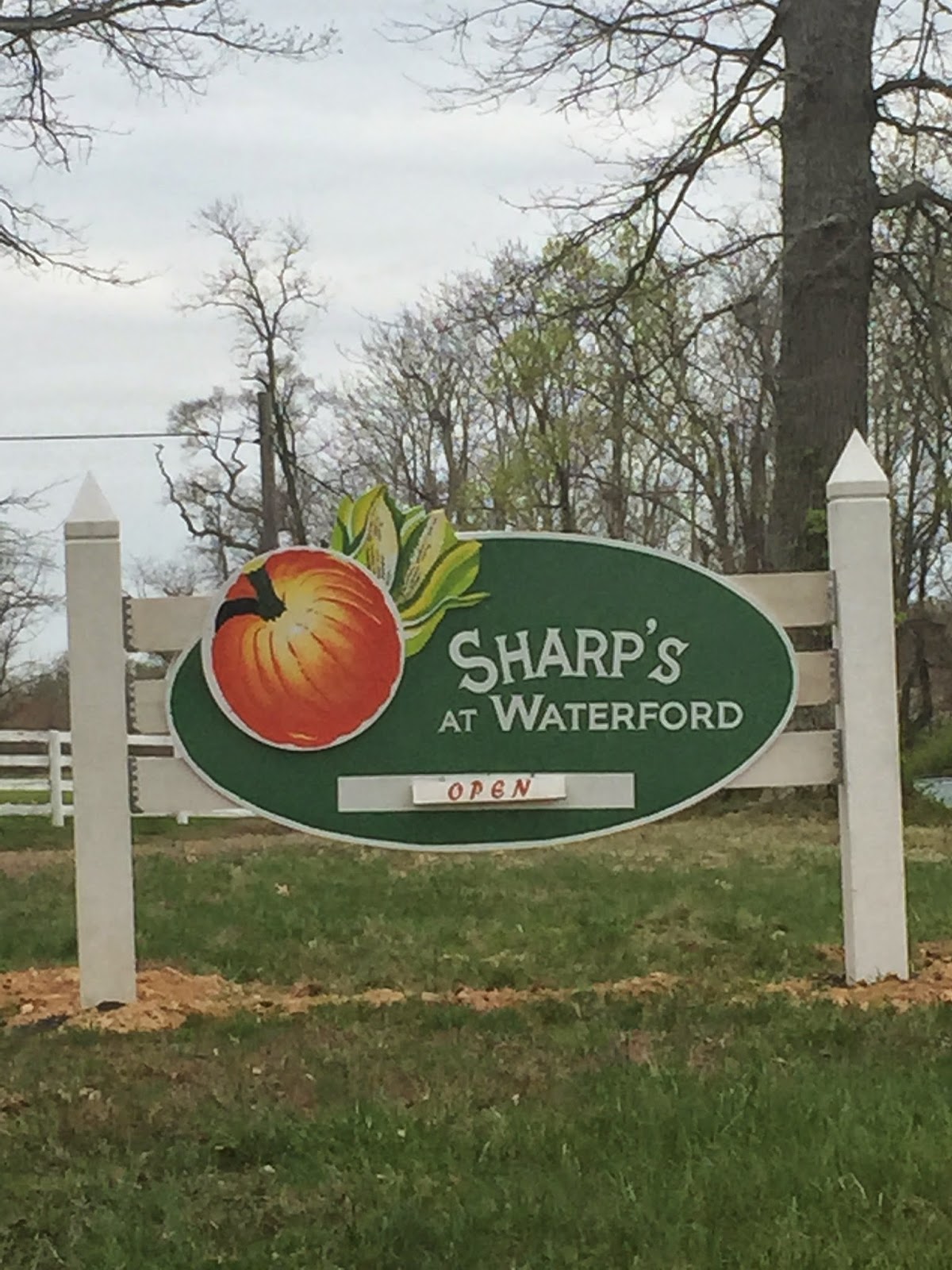
From there, I drove over to “Sharp's at Waterford Farm” www.sharpfarm.com .  This is a 530 acre working farm, family-owned and operated since 1903.  From mid-April through mid-November (during the week), they offer a variety of educational programs and tours.  I may have to go back as I honestly wanted to see one of the presentations entitled, “The Wonderful World of Worms.”  Although this class is described as “a great introduction for children to learn how they can make a difference in the environment by learning about composting,” it is for Ages 4 and Up, so I’m going to throw in the “Up” card when I come back.  I, too, would like to see the entire cycle, from food scraps or other organic waste, to the final product.  Additionally, some of the points covered in this class are: 

 
•What are the body parts of an earthworm?
•What do earthworms eat?
•What is compost?
•How do you make a compost pile?
•How do earthworms improve our soil?
•See actual working worm composting bins!
 
As today is Saturday, I was only able to look at the numerous farm animals and walk through the LARGE greenhouse with starter plants for sale.  Check out this cute little baby donkey with his mama!  Hopefully, I will be able to get back here during the week to see/experience more things.

It looked like rain was beginning to move in, so I decided to “call it a day.”  As I drove out of town, it was amazing to realize that a town with so much significance to our Nation’s history was less than an hour’s drive away.  I am really looking forward to my next Maryland adventure. 
Until then, I may have to craft an email to Guy Fieri……..

Sunday, March 15, 2015

A is for Accident, Maryland

A is for Accident, Maryland.  I do not think it was an accident that this was the first place I was destined to visit.  This little gem was a quaint, charming town (population 325 in 2014 and a total area of 0.5 square miles!) in Garrett County (western Maryland) and an absolute joy to visit for the day (location https://www.google.com/maps/place/Accident,+MD+21520/@39.6241797,-79.3250521,14z/data=!4m2!3m1!1s0x89caadbb8131a801:0x4eab37eb4cf8f1d2).  The drive, the lunch, and the couple of the town's "must sees" made the day complete and never once made me regret the close to three hour drive to get there. 

Before I continue with my experience, here are a couple of theories as to how the town got its name:

In “Flowery Vale:  A History of Accident, Maryland”, local teacher Mary Miller Strauss describes a potential history of the naming:

In 1774, Lord Baltimore, Proprietor of the Maryland Colony, opened his lands “westward of Fort Cumberland” for settlement.  Among the speculators who hastened to western Maryland with their surveyors to secure choice tracts of land were Brooke Beall and William Deakins, Jr., both of Prince George’s County.  William Deakins and his brother Francis had warrants for several tracts, and on April 14, 1774, they surveyed a fine tract of 682 acres between the branches of Bear Creek, including an old Indian camp ground on the trail to Braddock’s Road.  But when the survey was completed, Brooke Beall and his party appeared on the scene and Beall claimed that he had selected the same tract for his survey, calling attention to his axe marks on the trees to prove his claim.  Deakins replied that it appeared that they had selected the same land “by accident”.  Since he and Beall were friends and land was abundant, [Deakins] proposed that Beall take over his survey already made.  To this Beall agreed.  John Hanson, Jr., Deputy County Surveyor, made out the survey to Beall, and they named the tract Accident.

I think that account tells the story more of a mishap.

A second account traces the name to 1750:

King George II of England paid off a debt to George Deakins by giving him 600 acres of land in western Maryland.  Mr. Deakins sent out two parties of engineers – each without knowledge of the other – to find and survey the best land in that section of Maryland.  When the engineers returned, they discovered, much to their surprise, that they had each marked the same oak tree as a starting point and then marked off the same 600 acres.  Mr. Deakins considered it safe to choose this land and had it patented as “The Accident Tract.”

Either way, the town really got its start between 1750 and 1800.

By the time I arrived to Accident it was lunchtime, so my first order of business was to go to the restaurant I couldn’t wait to try.  You see, when I was conducting the research to figure out what I was going to do/see when I got to Accident, I discovered that one of four restaurants in town was the Moonshadow Café and Bar.   I was absolutely thrilled to learn that the restaurant served farm fresh food – real food that isn’t processed.  The food is made in house and they only purchase local, organic, and/or fair trade, as much as possible.  Additionally, it was very affordable. 

However, before I continue with my restaurant experience, I want to talk about my initial thoughts when I crossed the town border.  It was Friday and I was traveling on Main Street.  I passed by a couple of churches, the sign for the Drane house (which I’ll write about later), a few houses lining the street, and a few souvenir stores and businesses.  It was not a town designed for tourism (those places are further up the road – Deep Creek Lake, Wisp).  The buildings were apart from one another and not overly decorative, but not rundown, either.  The hardworking individuals living here took pride in their town and made sure litter did not line the streets.  I didn’t see anyone walking around and assumed that it was because it residents were at work (probably commuted) or in school in a nearby town.  I didn’t even see many motorists, which was odd because it was lunchtime.  Overall?  A very nice impression.

Less than 30 seconds after crossing the border, I arrived at the Moonshadow (http://moonshadowcafe.com/)

Nothing fancy to speak of with regards to the outside the building.  After I parked, I noticed one of the employees was walking out of the back of the building talking on his cell phone – he was wearing a crocheted beanie (very artisan.)  I knew IMMEDIATELY that I was going to love my dining experience as the combination of real food and artisan ambiance (read about that in my research about the place) would make my day complete.  I walked in the building and was not disappointed.  Décor was very “artsy”, saw flyers hanging on a bulletin board by the front door for paint classes, live music shows, local goods, craft brews, and art gallery – all at this establishment.  The music?  Indie.  I love that genre of music and after a three hour drive, I felt like I was in paradise.  I was asked to sit wherever I wanted and a menu was delivered by Leslie.  I was pretty much the only customer at the time as the restaurant opened at 11:00, too.  Hmmmm…..what to order, what to order……everything looked so good.  It was a menu filled with selections appealing to both Vegetarians and Carnivores.  I settled on the Quinoa Burger with beets.  A few minutes later, three ladies walked in and sat down at the table next to me.  As I waited for my food, a song caught my ear, and I downloaded the song (sung by Ben Harper) on my phone to listen to later.  I looked around at the décor, which was filled with mixed media, and smiled at the ladies catching up with what was going on in their lives.  Big smiles – my food had arrived!  And this is where I admit that my blogging skills are slightly amateurish, my friends.   I inadvertently cut the burger in half BEFORE I snapped the photo! 


So, after I remembered that I should have left the burger intact, I attempted to push everything back together on the plate to get the photo for this blog.  How was the burger you ask?  Pick a word – amazing, unbelievable, heavenly, delicious, scrumptious, to die for, blissful, divine…..shall I go on?  Basically, I tried very hard not to inhale the thing!!!!  I suspected everything else on the menu was equally as delicious, as well. 


Upon floating back down to Earth, I started to talk to the three ladies the next table over.  I told them why I was in town, about this blog, and if there were any other sites I needed to see.  They told me (in not so many words) that I was not permitted to go home until I went across the street to visit Pablo at Firefly Farms and at least took pictures of the Drane House.  I told them I would, thanked them for the suggestions of places to visit, paid my bill, and promptly went to visit Pablo.  As I was leaving, I saw that “Mateo Monk + Paapa Nyarkoh” (World Roots + African/Reggae (the Wailers drummer)) were playing tomorrow evening at this small venue.  I would have loved to see them!

I also found out that the owner of this restaurant (Lisa) also owns 14 micro-cabins at an eco-friendly vacation village at Deep Creek Lake (in neighboring McHenry, Maryland) called, “Blue Moon Rising.”  Basically, they are partially built out of locally sourced reclaimed lumber and “creatively fits the comforts of home into a cabin in the woods.”  From what I understand, an article was written about these cabins and was featured on Mother Nature Network.

Firefly Farms (http://www.fireflyfarms.com/) is a creamery and market that makes award winning, handmade cheese ON SITE from goat’s milk and, just recently, cow’s milk.  When the business first started, they purchased 50 goats which evenutally grew in population to over 150.  They sold the goats and started purchasing goat’s milk from local farmers (Amish, included) along with a bit of cow’s milk.  The company ships worldwide and also does a lot of their business along the Eastern seaboard.  For those who are interested, they distribute to Whole Foods, as well – at least the ones in Maryland (I failed to ask about the locations.)  Pablo was VERY informative – he provided extensive information on their cheese and gave me samples of five of their cheeses (I don’t normally eat cheese, but I figured I would try a bit of this award winning creation!)  He also gave me a brief overview of the company and showed me the different stages cheese goes through. 
You can actually see some of the stages through the two windows positioned at the back of the store.  I’m not sure if Pablo would normally provide the in-depth information that he did that day.  However, the day I visited was, again, Friday and not a lot of people were in the store.  I would classify the store as “Gourmet” where you could purchase:  the handmade cheeses, crackers, bread, condiments, jams, wines, and cured meats (just to name a few.)  The store also has wine tastings.   I purchased some of the goat’s cheese, which I had a sample of.  Of course when they cut a wheel, it’s always an estimate with regards to weight.  So, when you say you would order, say, a pound, it’s not always exact when they weigh it.  However, when they “do” get it exact, they ring an antique bell with a clacker.  Unfortunately, Pablo cut my order a little short of a pound, so I didn’t get to hear the bell – darn!  I found the experience very, very enjoyable and informative and I’m so glad I stopped in for a visit. 

I looked at the time and decided that I should probably part ways with the town I was having so much fun visiting.  And then I remembered that I needed to at least take a picture of the Drane House, which is Garrett County’s oldest standing house.  Here is a bit of history on the Drane House per the Mayor, Town Council, and The Accident Cultural and Historical Society:


Accident is the site of the historical Drane House.  The Drane House was built in 1798 by William Lamar and was given to his sister and her husband, Priscilla and James Drane in about 1800.  The Drane House was purchased by the Town of Accident in 1987, reconstructed and preserved on the original site, and dedicated in 1994.  The Drane House is a key landmark in the early history of Western Maryland and a vital part of its heritage.  In fact, it is believed to be the oldest standing structure in Garrett County.  The house is sited on a high ground to the east of the Town of Accident approximately 150 yards from the Accident-Bittinger Road and one-half mile east of U.S. Route 219.  The structure is significant for its architecture and for its association with the early settlement of Garrett County.  The house was constructed circa 1800 by James Drane, the first permanent settler in the Accident area, itself and early community in Garrett County.  Drane immigrated to Western Maryland from the tobacco farming area of Prince George's County and was one of several early farmers who attempted tobacco culture in Garrett County.  These efforts were ultimately thwarted by the cool climate and the great distance to market.  The Drane House serves additional significance from its architecture, representing a highly unusual combination of the log and frame construction techniques and an uncommon variant of the hall-and-parlor plan type.

I didn’t realize I had to make an appointment to tour the establishment and feel badly that I didn’t have that experience to share with you.  However, I “was” able to drive down to the location for some photos.

My visit to my “A” town was complete.  As I departed the town, it felt good knowing that my overall experience was an excellent/rewarding one and am happy to share this with those who are interested in reading about what I am doing – finding the hidden gems of Maryland .  To me, hidden gems are the towns that everyone whizzes through on their way to the bigger cities with the touristy climates.  These are the towns that are only known as names on signs on the sides of highways.  These are the towns that most people have no interest in visiting because there is something bigger and better in sight.  However, given the chance, exciting activity can be found in small towns – I look forward to the pursuit of my next big adventure. 

Until then, I’m going to listen to the Ben Harper song I downloaded earlier in the day and smile.