Tuesday, June 30, 2015

D is for Deal Island, Maryland

D is for Deal Island, Maryland.   Making the 2 ½ hour drive to the town I personally nicknamed “Mayberry by the Bay” was not difficult at all (click here for a map).  My interest in visiting this town was prompted by wanting to see one of the few remaining working Skipjacks left in the world.  You are probably wondering what a Skipjack is, right?  Ah, you are just going to have to wait!

Deal Island is a Census Designated Place (CDP), which is a populated area lacking a separate municipal government, but which otherwise physically resembles incorporated places.  It is located in Somerset County and is included in the Salisbury, Maryland statistics.  Deal Island has a population of 471 and covers an area of 5.4 square miles - 3.2 square miles of it is land and 2.1 square miles of it is water.  Historically, it was known as Deal’s, Deil’s and Devil’s Island.  At least one source also attributes these nicknames to the area’s use by pirates.  

I found to be this to be an accurate description of Deal Island:  Deal Island is one of the last Bay type water and land mosaics on the East Coast left unblemished and untouched by the sprawl of modernism.

As I got a bit of a late start on my journey, lunch was the first order of business when I got to Deal Island.  I read earlier there were two restaurants to choose from, so I decided on a place called “Arby’s General Store”. 
Arby’s is a three part store – beer/bait/tackle; restaurant; bar located across from the newly-refurbished public marina.  As I found out, it is not only the “comings-and-goings” of the Maryland eastern shore fishermen and the trappings of a real fishing village that makes this place special, it is the food.  Arby’s has a varied menu with excellent food at modest prices.  It is a great place to eat if you are going on a fishing charter or you have a boat you are launching from the marina/boat ramp across the street.  As it was lunchtime when I got there, I was hoping to see some of the fisherman unloading their catch as I got to the restaurant.  I did, but not until I finished eating.

Initially, I was the only person in the restaurant-bar area (“areas 2 and 3” of the establishment).  About 10 minutes later, I saw some fisherman walking over from their recently docked boats.  The woman acting as cook/waitress/busboy/barkeep motioned me to sit down where a menu was already on the table.  As always on my visits to these small towns, I wanted to order something local.  As I am a fish/no red meat/no chicken eater, I settled on a Crab Burger (with no bun), which was described as crab meat, spices, and cheese.  In my mind, I’m thinking I would be getting something similar to a crab cake.  Wouldn’t you?  What I actually got was a hamburger patty, topped with crab meat, spices, and cheese!  BIG DIFFERENCE!!!!!  I simply ate everything but the hamburger - it was still delicious and filling.  Lesson learned – ensure you know what you are really getting before you order!

As I was getting ready to leave, an older gentleman walked by, smiled, said “hi”, and continued on back to the beer/bait/tackle area of the store.  Since water was sold back there, I decided to check out “area 1” and make a purchase.  I complimented him on his hat (Bacon Lover) and he proceeded to have a conversation with me – beginning with the history of the hat.  I found out his name was Arby – the owner of the store(s).  He was extremely proud to tell me he has been working in the store for 31 years.  He was born in the house that once stood in the backyard of the store and lived in there until 2003 when Hurricane Isabel struck and generously deposited 20 inches of water in the house, condemning the structure.  It was then demolished and he moved about a block down the road.  He joked the move increased his commute time, but he has a better view of the Bay.  As I was talking to him, locals kept coming in, friendly “hello’s” were thrown about (by name), and if someone wanted to exchange something (i.e., lures) or return something, he would always add on an imaginary “Restocking Fee” to the refund.  Arby was extremely entertaining with his stories – I could have easily listened to what he had to talk about for many more hours. 

However, I needed to start my adventure and at this point I asked Arby about the Skipjack.  Before I continue with what Arby had to tell me, here is a brief description of a Skipjack (per Wikipedia):

"The Skipjack is a traditional fishing boat used on Chesapeake Bay for oyster dredging.  It is a sailboat which succeeded the Bugeye as the chief oystering boat on the bay, and it remains in service due to laws restricting the use of powerboats in the Maryland state oyster fishery.  Due to state laws, the boat has no motor (other than for the windlass).  Most skipjacks were eventually modified with stern davits to hold a dinghy or pushboat to allow motorized travel as permitted by law. The Skipjack arose near the end of the 19th century.  Dredging for oysters, prohibited in 1820, was again made legal in 1865. Boats of the time were unsuitable, and the Bugeye was developed out of the log canoe in order to provide a boat with more power adapted to the shallow waters of the oyster beds.  The Bugeye was originally constructed with a log hull, and as the supply of appropriate timber was exhausted and construction costs rose, builders looked to other designs. They adapted the Sharpies of Long Island Sound by increasing the beam and simplifying the sail plan. The result was cheaper and simpler to construct than the Bugeye, and it quickly became the predominant oystering boat in the bay.


Maryland's oyster harvest reached an all-time peak in 1884, at approximately 15 million bushels of oysters.  The oyster harvest has since declined steadily, especially at the end of the 20th century.  The size of the fleet has likewise declined. New Skipjacks were built as late as 1993, but a change in the law in 1965 allowed the use of motor power two days of the week.  As a result, few of the boats are operated under sail in commercial use; instead, a pushboat is used to move the Skipjack, and little dredging is done except on the days power is allowed.  At one time, the number of Skipjacks produced is estimated at approximately 2,000; today, they number about 40 with less than half of them in active fishing.  The future of the fleet remains in doubt as efforts continue to restore the productivity of the oyster beds.  The Skipjack was designated the state boat of Maryland in 1985".
 

Arby told me there was a Skipjack located across the street in the marina.  Her name is Fannie L. Daugherty which was built in 1904.  She is one of the 35 surviving traditional Chesapeake Bay Skipjacks and a member of the last commercial sailing fleet in the United States.  He continued to tell me Skipjacks are not permitted to harvest oysters until 1 November whereas the smaller boats are permitted to harvest on 1 October.  Arby also told me there was another Skipjack nearby.  He took me outside, pointed across the harbor, to the tall mast in the distance.  Arby told me the Skipjack named City of Crisfield (built in 1949) is captained by Captain”Daddy Art” Daniels, a 93 year old Skipjack captain who is the oldest captain still working the Chesapeake.  I asked Arby if he thought Captain Daniels may be over at the Skipjack so I could talk with him, but Arby said probably not because it was getting quite warm out.  We finished the conversation with Arby telling me about the Annual Skipjack Race occurring on Labor Day Weekend where usually 7 or 8 Skipjacks would be racing.  This year would be the 56th year for this spectacular annual event and it is hosted by the Deal Island Chance Lions Club.  I told him it would be a strong possibility I would be back for the event, thanked him for his hospitality, and walked across the street to see the Fannie L. Daugherty.  I also wanted to see if any boats were coming back with crabs.

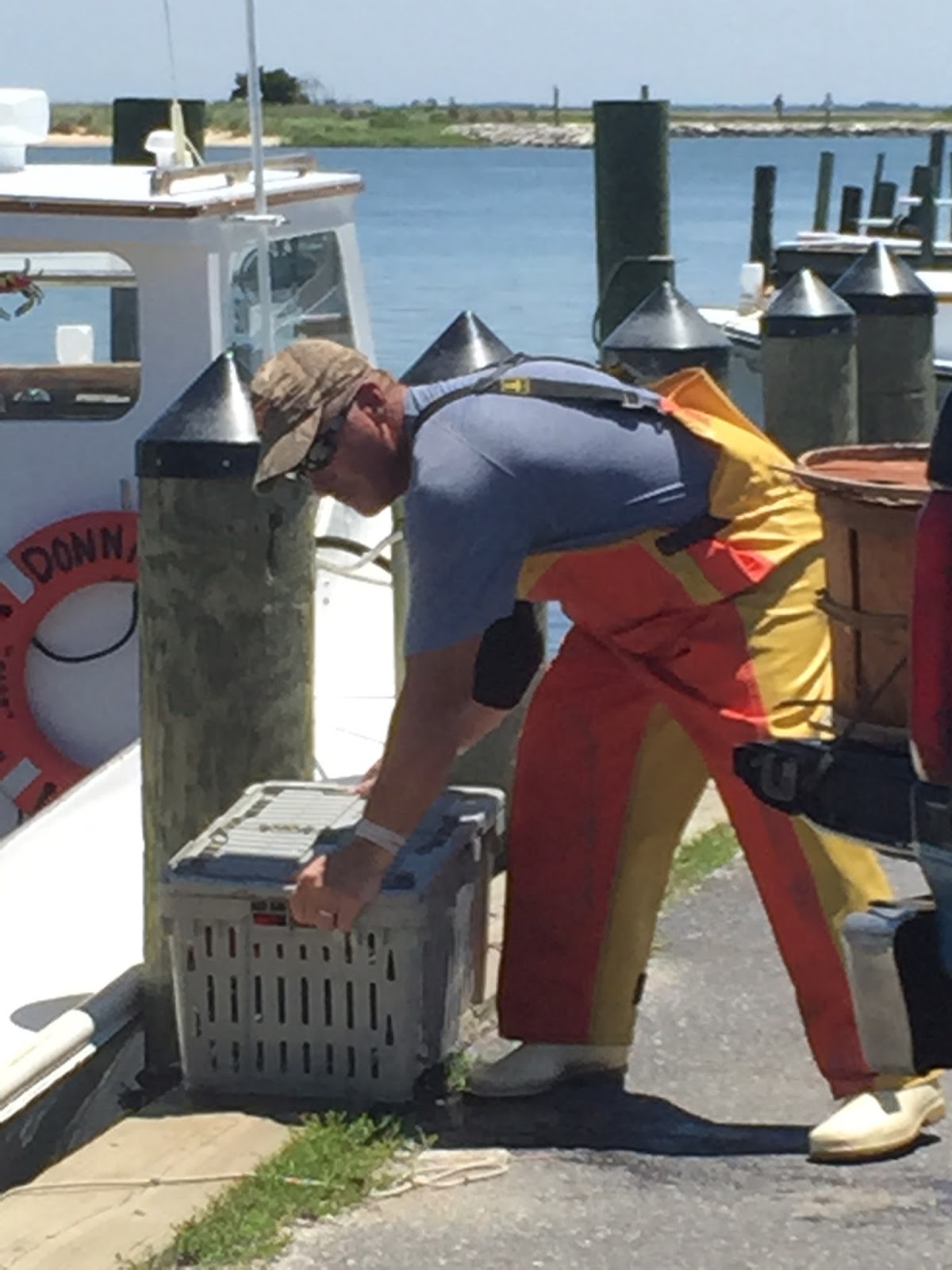
The Fannie L. Daugherty was beautiful!  Remembering she was built in 1904, she looked practically new and it was evident she was well taken care of.  The mast was beyond impressive and I can only imagine the sight of her when she is in full sail.  As I was snapping pictures of her, a commercial fishing/crabbing boat pulled into the docks.  I made my way over to the boat and saw it had quickly docked and the fishermen were unloading countless crates and bushels of crabs onto the back end of a pick-up truck.  Lots and lots of Chesapeake crabs!!!!  The driver then got in the truck and drove away.  The entire operation (likely, routine) was over in what seemed like a few short minutes.
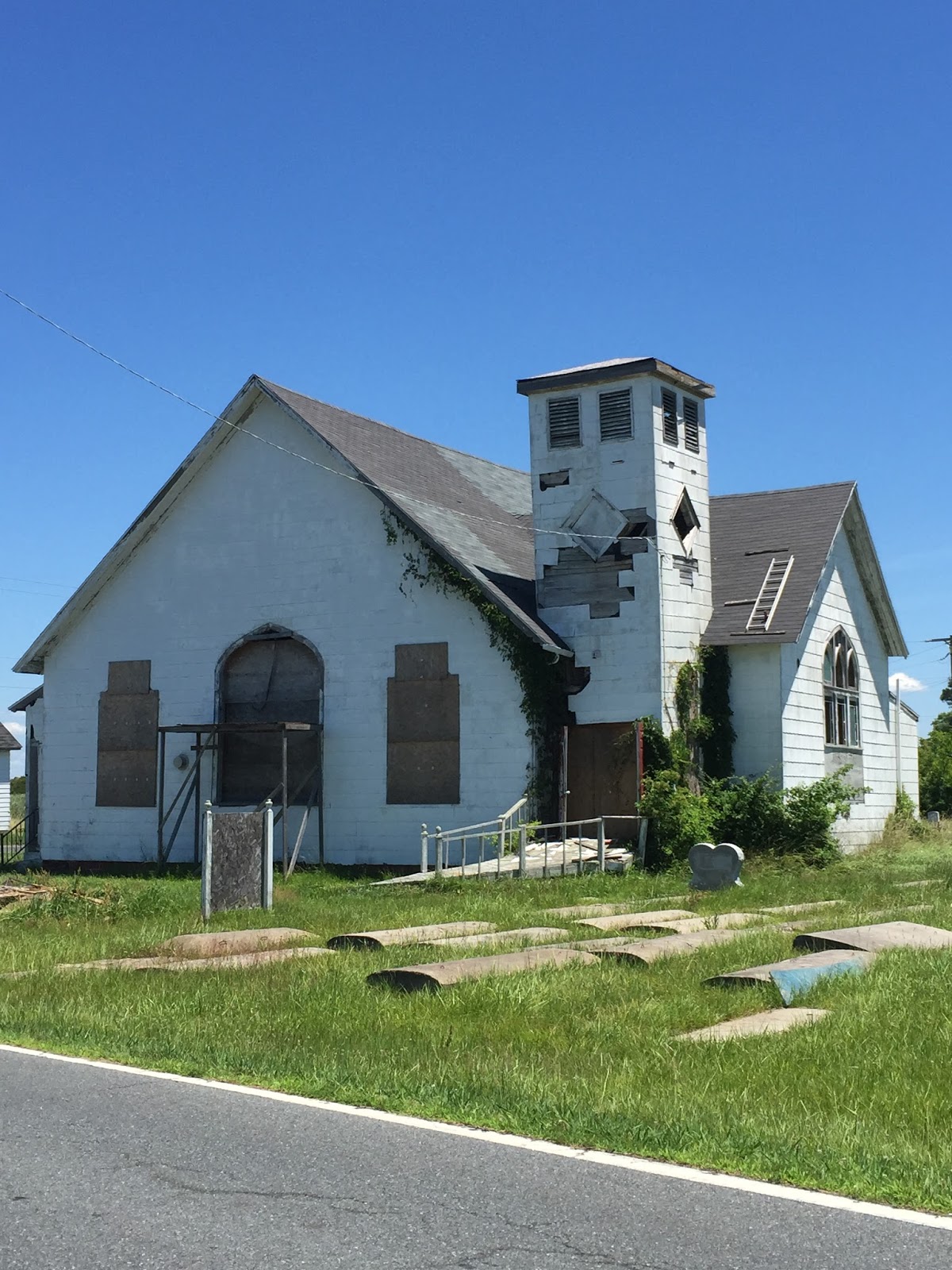
I had one more stop to make – The Deal Island Wildlife Management Area (WMA).  On the way, I passed “The Deals’s Island 1908 Bank Building”, which is For Sale by Owner.  I also passed a church with a sign out front reading, “The John Wesley Restoration Project”.  After careful research, I found a short article in addition to a Facebook post, which read:

An article written in February 2013 about this church and cemetery:  “John Wesley United Methodist exhibits some greater past that’s been forgotten, neglected.  The church was once a cornerstone of the African American community on the island, but declining membership caused it to be shuttered, and a decade of neglect shows in the glass-less windows, and the cracked and waterlogged cemetery vaults.  A restoration effort appears not to have picked up much steam.”


Facebook post:  "Efforts are under way to help preserve the only remaining African American Church, on Deal Island, Maryland.  This Church is in desperate need of repair and if we don't act now the building will fade away."

I was able to roam around the small church yard and found some graves in the adjoining cemetery to be those of fallen Soldiers.  Sadly, there were also some small torn flags lying about the grave sites.  It would be wonderful if the grounds could be cleaned up in the near future.

On to the WMA.  What is the WMA, you ask?  Here is a little information about it:

"Expanses of tidal marsh, frequently broken by open water, characterize most of the habitat of this WMA. The 13,000 acre property also contains forested wetlands and a 2,800-acre man-made pond or "impoundment."  The water insects and crustaceans, as well as the abundance of Wigeongrass, Horned Pondweed and other favorite waterfowl foods makes Deal Island one of the best places in Maryland to watch, photograph and hunt ducks and geese.  [Basically] ducks, geese, swans! Waterfowl are the featured performers on Deal Island.  Many, many species of waterfowl, in all their colorful splendor, nest, feed, and migrate through this area.  Deal Island also supports one of the largest concentrations in the state of Herons, Egrets and Ibis.  One of Maryland's only breeding population of Black-Necked Stilts thrive here. The rare Eurasian Wigeon, a type of duck, is frequently seen in the large flocks of American Wigeon that spend the winter in Maryland".

I read you could park and walk the gravel/dirt road into the area.  However, the area began immediately as you turned off of the main road and there was not a parking lot I could find, so I decided to drive the one lane road.  I found the reeds and Cattails came right up to the sides of the road I was traveling, so if another car was coming from the opposite direction it would be a VERY tight squeeze and a very strong possibility one of us would probably go into the watershed!  Luckily, I was alone on the small road the entire time and what an experience.  I had the entire WMA to myself!  Cranes, Loons, and even a couple of Bald Eagles held my gaze along with plenty of Red Wing Blackbirds.  I never saw a Baltimore Oriole, though.  I have always hoped to see one since moving to Maryland, but never had the luck.  I read Orioles were pretty prevalent in the WMA, but they must have been playing an Away Game today!!!  I quietly drove the road for roughly ½ hour, was able to find a place to successfully turn around, and got back on the main road to head home.  I wish I could have stayed longer, but then I always do when I visit these types of places.  I “will” be back, though!

Earlier, I mentioned I personally nicknamed Deal Island “Mayberry by the Bay”.   The people were down-to-earth, charming, and friendly - I was made to feel welcome by everyone I came in contact with.  The slower/relaxed pace of life on the Bay is something not many people will ever get to experience, and I feel fortunate I had the rare chance to be afforded this opportunity.  Deal Island is definitely a hidden gem worth exploring!    

In memory of my friend Tom – a model Soldier and family man I had the honor and privilege to serve with.


Sunday, May 17, 2015

C is for Clear Spring, Maryland


16 May 2015
C is for Clear Spring, Maryland.  It took a little more than 1 ½ hours for me to drive to this little gem and I was very anxious to see this town, which I eventually found to have a very old-time, and somewhat Mayberry feel to it.  I was even more anxious to see this town as I discovered the National Pike Festival was going to be celebrated today.  Each May, this celebration occurs because Clear Spring was a gateway on a 300 mile wagon train route back in the 1800s. The festival includes a wagon train reenactment covering 40 miles of this route.  Before I continue with this and the rest of my experiences in Clear Spring, I’ll provide a brief description of the town.

Clear Spring was founded in 1823 (you blink and you’re through it) and is located in Washington County roughly 12 miles from the Pennsylvania State line (click here for a map).  This town (incorporated in 1836) has a population of 358 people and covers an area of 0.11 square miles.  One of the interesting things about this town is it houses Washington County Public Schools' Academy of Agricultural and Environmental Science - a program available to any student enrolled in Washington County Public Schools regardless of their home district.

So, how did Clear Spring get its name?  I only bring this up because I ran across a little sign pointing to the spring the town was named for.  Well, this spring just got added to my list of things to see in this town.  When I reached the spring, I was surprised to see it was just a concrete path guiding the flow of water.  However, today it was “standing”, not flowing.  I really wanted to see where it originated, but I was bordering private property, so I didn’t continue my search.  It must have been significant, though, as this town was named after this spring.  Per the Washington County Historical Trust:

 “The clear spring still flows at the foot of Fairview Mountain on the south side of what first was called the Bank Road.  Now Route 40, it once was dirt and gravel highway to the west that completed the connection between Baltimore and Cumberland by 1823.  At Cumberland, it joined the National Pike, which went west from there.  Having the spring close to the road made this an appealing place for coaches and wagons to stop and refresh both travelers and teams.  A sign directs the passerby to a double walkway between 109 and 111 Cumberland Street.  Back behind the houses, the spring emerges from beneath a stone bulwark and flows into a concrete basin.  It then proceeds across backyards in an irregular path of man-made channels.  Still as cool and appealing as it must have been 150 years ago, the spring is now accompanied by a sign warning that it should not be tasted.”

Now, off to discover the festival where I was actually a little more interested in finding the wagon train.  I read it would momentarily stop at the Wilson Store at a specific time (on this day) and I was very close to meeting the timeline.  As part of the festivities, the one room school house (Wilson School) would be open for a self-guided tour, as well. 

Here come the wagons!!! 

VERY impressive!  Everything from horses and approximately 15 covered wagons, to a stage coach were there – even a few Confederate soldiers.  Held every year since 1989, this fun-filled community event provides visitors with an authentic wagon train experience (highly reminiscent to the 1800s era) during the time when Western Maryland was a frontier and everyone relied on wagons and horses.  As mentioned earlier, the route was 300 miles.  It was created by the Federal Government eventually to become known as the National Pike.  Per Wikipedia:

The National Road (also known as the Cumberland Road) was the first major improved highway in the United States to be built by the Federal Government.  About 620 miles (1,000 km) long, the National Road connected the Potomac and Ohio Rivers and was a gateway to the West for thousands of settlers.  When rebuilt in the 1830s, the Cumberland Road became the first U.S. road surfaced with the Macadam process pioneered by Scotsman John Loudon McAdam.

In 2000, the James Shaull Wagon Train Foundation was formed.  According to the foundation’s website, the name was given in honor of James “Jimmy” Shaull, who was a farmer of Belgian horses and was Wagon Master for the National Pike Festival in 2000.  Unfortunately, Shaull died shortly afterward in a tractor accident. 

The wagon train does not cover all 300 miles – only 40 of the miles.  I should also tell you that unless you are part of the reenactment team with your own wagon and horses, you don’t actually get to ride on the wagon train - you only get to be a spectator.  To get an idea of what one of the modern day participants went through, this is an excerpt from a 2010 Herald Mail Media interview with Ms. Jeanne Ward of McConnellsburg, PA:

“Wagons roll in all night that first Friday, as the group stays together in Clear Spring, before preparing to head out early Saturday morning. The nearly 40-mile trip takes the wagons through Clear Spring and right through the center of Hagerstown before heading to Funkstown to the encampment, where they stay the night, before wrapping up the journey in Boonsboro the next morning.  However, everything in the process is required to be authentic, Ward said.  “We can’t have coolers showing and no cell phones.  It has to be all steel tires, no rubber tires on the wagons.  You can’t wear T-shirts with logos,” she said, adding that many people enjoy coming up to the wagons and looking inside.

Ward and her husband finally have a pair of matching Belgian horses to pull their wagon.  It is the campfires that Ward said she is looking forward to the most.  “I love the campfires in Funkstown.  We have harmonicas and banjos, and we sit around a big campfire and have music and food,” she said.  “It’s a really educational moment to come out and bring your children to see this. It’s history in the making,” Ward said. “It’s a real feel for how things were a long time ago.”

After spending a considerable amount of time looking at the wagon train and visualizing what it must have been like “back in the day,” I decided I wanted to explore the Wilson Store.  In working my way over to the store, I heard music playing and found a small group of people had formed who were playing mountain music.  One of the Confederate soldiers was playing the harmonica, as a couple of “civilians” were playing the guitar and banjo. 

It was extremely enjoyable – the mountainous background of the town, the music, and the sight of the wagon train threw me right back into yester-year.  I listened for a bit and when they took a break, I went into the store.  Wow!!!!  Check out this Pot Belly Stove!  And I never saw so much “penny candy” in my life!  There were abundant old time candy jars on the counter filled with to the brim with licorice, gumballs, caramels, and many other yummy treats.  Alexis was the store’s very happy salesperson and extremely helpful with answering everyone’s questions.  I stayed just long enough to look around to admire/appreciate all of the antiques and left to tour the one room schoolhouse located next door.

The Wilson School proved to be an interesting experience.  Built in 1855, the school was finally closed in the 1950s after being open 103 years.  At one time the school actually had as many as 50 students!  There was a “teacher” at the front of the room already discussing the history of the school as I walked in (I guess I was tardy), so I was not there for the entire lesson.  So, I’ve taken a little history about this school from the Wilson Village site:
 
“[The Wilson School] was a labor of love and produced by Rufus Wilson.  His wife and two of his children had died and he was reluctant to let his only remaining child, John, travel far to attend school.  He offered land next to his home and store to the county for a school.  Used by the Washington County Board of Education until 1955, it has been restored to such a magnificent extent, the visitors remark it looks as if the children had just gone out to recess and were expected back any minute.  Rows of old-fashioned wood and wrought-iron school desks are lined up inside the school room facing the school master’s or marm’s desk at front and center.  An old piano sits against one side wall.  A recitation bench – where students would wait to stand and recite their lessons – is in front of the blackboards.  Little hats and coats are hung in the area just inside the door.  A sleigh used to pull wood is propped against a wall.  Textbooks, a washbasin, and mirrors are at hand.  Even the dunce’s cap and stool sit waiting in a corner.”
 
After the teacher “dismissed” me, I decided I would drive over to the Windy Hill Restaurant to experience some local cuisine.  I was greeted by Ching,  
the manager, and was seated at one of the 10 tables in the restaurant.  As busy as he was, Ching couldn’t have been friendlier to everyone in the room.  He told me the Homemade Salmon Cake sandwich was very good, so that was good

enough for me.  As I was waiting for my sandwich, I began talking to the two ladies sitting at the table next to me until my food arrived.  They were Canadian tourists simply passing through on their way to Washington, DC.  When my sandwich arrived, it definitely did not disappoint!  Ching was “spot-on” with his recommendation.  I paid Ching, thanked him for his hospitality and recommendation, and left.

From there, I ventured over to the Knob Hall Winery – a very popular winery in Maryland.  It took just 15 minutes to drive there.  When I got there, I walked over to where some employees were setting up tables and chairs.  One individual saw me and asked if I was there for a wine tasting.  I told him, “no” and asked if I could just look around.  He happily said I could, but suggested I experience a wine tasting.  I nodded, “alright,” and he kindly motioned me towards the barn (where a few people were standing/working), instructed me to go over to the bar, and would be in momentarily.  Baxter, the establishment’s dog, showed me the way.  

When I got to the entrance of the barn, I wasn’t sure where the bar was located, so I asked a girl who was arranging papers and flowers on a table if she worked there.  She smiled and said, “no” – she was the BRIDE.  Ummmm……..wow!  Awkward!  I apologized and explained what had happened (and promised I wasn’t there to crash her wedding.)  She laughed, said, “no worries”, and politely pointed me in the direction of the bar.  When I got there, Amy (who I later found out was a tattoo model, as well as an employee of the vineyard)
met with me and asked me to have a seat.  Every seat at the bar was open as I was the only one at this tasting.  Gee…..I wonder why!

Amy provided me with a brief history of the winery.  The 43 acres of land was in the family for over 200 years and they planted their first grapes in 2007.  They’ve won numerous awards for their wines as well – it’s THAT good.  The barn is used for events (see paragraph above), parties, bands, and wine tastings.  Amy told me one of her co-workers sometimes caters for the wine tastings.  Additionally, the house adjacent to the barn is partially used as a B&B.  So, on to the wine tasting.  For $5.00, I was able to taste 6 of their 15 available wines.  Amy described each one of them with great detail and was extremely helpful in answering my questions.  In the end, I bought a bottle of one of wines I tasted named Le Reve Rouge (French translation – “The Dream Red”), which Knob Hall nicknamed, “A Wine for Everyone.”  Amy explained this wine is for lovers of both red and white wine, and very few people do not care for the taste.   I thanked Amy for the education and excused myself before the wedding began.  As I was leaving, she suggested I go out back to see the Guinea Hens and Peacock roaming around.  Happily, I took her advice and remained back there looking at the beautiful birds for a few minutes before I drove home.


I found Clear Spring to be another pleasant, small town to visit.  I was excited to visit this town before I made my journey and the excitement never faltered.  Today, “I was a fly on the wall” in a town with tradition and a celebration of history both the local and neighboring population take pride in recognizing.  Simply put……Clear Spring is a little slice of life!  


Sunday, April 26, 2015

B is for Brookeville, Maryland

B is for Brookeville, Maryland.  The drive would only take about 55 minutes and I was really looking forward to visiting the town that played a significant role in history.  On August 26, 1814, Brookville was named, “The United States Capital for a Day” during the British occupation of Washington and when President James Madison fled the White House.  More about that in a bit. 

Brookeville is a quiet town located in Montgomery County (less than 20 miles from Washington DC) with a population of 134 people and is mostly residential (location https://www.google.com/maps/place/Brookeville,+MD+20833/@39.1797554,-77.0547512,16z/data=!4m2!3m1!1s0x89b7d6d569ab0761:0xd785efeab880fa3b).  The town is formally incorporated and covers an area of 0.1 square miles.  Since Brookeville’s founding in 1794, the community has evolved and kept pace with the times, but never lost its historical integrity.  It has become home to people seeking the charm and comfort of a previous era. 

Some background on my town selection.  Friends have been giving me suggestions for future town visits.  One friend gave me the name of a town that was not coming up on my list of Maryland Cities and Towns.  So, I did an independent search on the town and found that it wasn’t on my list because the town was an UNINCORPORATED town. 

Hmmmmm………so, what is an UNINCORPORATED town?  Here are some interesting facts about these towns.  If a town is UNINCORPORATED, the town does not have a city government; the fire department is likely a volunteer one supported with fundraisers, donations, and maybe grants; what regulations there are, are County regulations; there may or may not be a Post Office; there likely will be a school or schools and, yes, the towns do have names.  But if you drove through one, you'd just think “this is a small town” - there's no real way to tell if a town is INCORPORATED just by looking at it.  Additionally, some of these towns can have hundreds to thousands of people.

So, back to Brookeville.  Brookeville was INCORPORATED by the Maryland General Assembly in 1808, which appointed three Town Commissioners – making Brookeville the oldest INCORPORATED town in Montgomery County.  Can you believe that?  This little 134 person town is INCORPORATED.  Pretty impressive!

As mentioned earlier, one of the reasons why I wanted to visit this quiet little town was that it played a significant role during the War of 1812.  In 2014, a Washington Post article summarized the history of this town as:

As the British burned the U.S. Capital in 1814, refugees from Washington D.C. and Georgetown fled to this [Brookeville] town.  President James Madison spent two nights in Brookeville as he sought refuge at the Market Street home of Postmaster Caleb Bentley.  The house is known today as, “The Madison House.”  In addition to providing refuge to the President and the U.S. Attorney General, Brookeville’s townspeople provided refuge for other Washingtonians fleeing the invasion and burning of the city, as well as American Soldiers from the Battle of Bladensburg making Brookeville “The United States Capital for a Day.”


The Madison House literally sits on the border of this town – the “Welcome to Brookeville” sign is posted in the yard.  People currentlyoccupy The Madison House as a residence, so this unfortunately this meant I probably wasn’t going to be able to take a tour.  I tried, though.  The owner was in the backyard cutting the lawn and was inaccessible, but I was hoping someone else was home.  No such luck.  More history…….The Madison House not only housed President Madison for two nights, it actually sits on top of the historical Underground Railroad http://en.wikipedia.org/wiki/Underground_Railroad.  According to “Pathways to Freedom – Maryland & the Underground Railroad”:

The Madison house at Georgia Avenue and Market Street has ties to the Quaker abolitionist community in nearby Sandy Spring.  Decades after the end of the Civil War, a secret room was discovered within the foundations of the house, which had long been rumored to be a stop on the Underground Railroad.  This room was accessible only by lifting the floorboards of the family room above it, then traveling the stone staircase.  An old gun was also found in the secret chamber.     

So, note to self…..in the VERY near future, sign up for the Free Weekly Guided Underground Railroad Hikes beginning in nearby Sandy Spring.  The hike lasts about 2.5 hours and is provided by volunteers who lead groups on a simulated Underground Railroad experience covering 2.0 miles along a wooded, natural surface trail.  Hikers will learn about various techniques that "freedom seekers" used to elude trackers, find food, and navigate their way north to freedom.  The Underground Railroad Experience Trail is part of the National Park Service program. 

From there, I drove by the Brookeville Academy, which is one of the first private schools in Montgomery County, built in 1810.  Now it serves as a unique community center used for meetings, social and cultural events. 

Not far from the Academy is The Valley House.  This is also occupied by residents as is The Madison House.  The Valley House is one of the oldest in Brookeville as it is one of the four remaining late 18th century buildings in the town.  It is believed that it was built by the founders of the town prior to Brookeville’s founding in 1794 (remember Brookeville was INCORPORATED in 1808 – different than when it was founded.)


It was still early in the day, so I headed over to the Brighton Azalea Garden.  Situated overlooking the Brighton Dam, I could easily see how the five acres of nothing but Azaleas would be quite breathtaking.  Unfortunately, we haven’t had the warmest/sunniest of spring days, so nothing was in bloom, yet.  However, the walk through the small wooded park proved to be VERY enjoyable as it was so peaceful.  Not a soul was around.  I had to keep reminding myself it was Saturday, too.


My stomach is rumbling……time for lunch.  So, I headed over to the Sunshine General Store (which has been around since the 1950s/1960s and used to sell gas) where they serve the FAMOUS Sunshine Burger http://peepmeat.com/restaurant.php?id=83.
From what I understand from my readings, there is actually a cult following with regards to these burgers.  When I got there, the place was packed!  I later found out that it’s like that from the time the place opens for business until the time they close.  And the intoxicating smell coming from the building.......heavenly!  I can really appreciate a good burger (even though it’s not on my personal menu)!  So, I made my way up to the order counter where I disappointed a bunch of turkey hunters by ordering……a PB&J.  However, I really wanted to get a glimpse of the burgers on the grill!  GINORMOUS as you can see by the picture!  A few minutes later, one of the ladies behind the counter yelled out that if anyone ordered a burger with lettuce, that they were out of lettuce – I smiled.  This was a pretty cool place. 

 
While I waited for my sandwich, a nice lady in the crowd asked if I was a reporter.  This was probably due to all of the pictures I was taking.  I told her about the blog - she became very interested in hearing about it and contributing what she could.  She told me about the places to visit in Brookeville (many of which I had already visited today), but I was thankful for the additional suggestions.  She smiled as she proceeded to tell me about the plans to pick up some Sunshine Burgers so she could surprise her children as they adored them.  She also told me of how she was thinking of sending an email to Guy Fieri of “Diners Drive Ins and Dives” about coming out here to review the place.  One of the turkey hunters chimed in that he wanted to do that, as well.  My sandwich was ready, but the six stools were taken at the counter and the one table was full, so I went out to my car to eat.  As I turned to look back at the establishment, I saw a “Live Bait” sign in the window and remembered seeing the live bait in the store – again, I smiled.  This was a pretty cool place. 


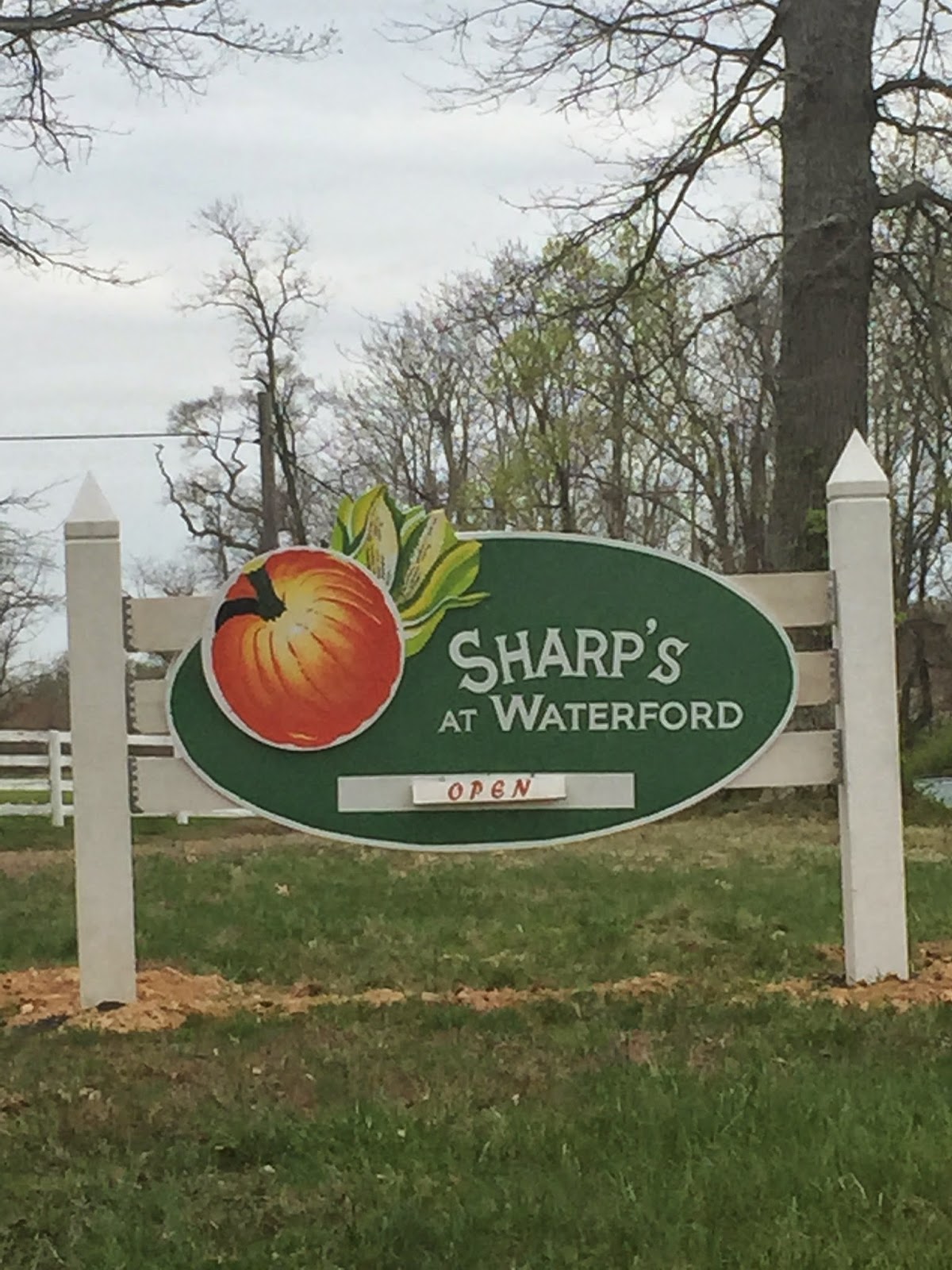
From there, I drove over to “Sharp's at Waterford Farm” www.sharpfarm.com .  This is a 530 acre working farm, family-owned and operated since 1903.  From mid-April through mid-November (during the week), they offer a variety of educational programs and tours.  I may have to go back as I honestly wanted to see one of the presentations entitled, “The Wonderful World of Worms.”  Although this class is described as “a great introduction for children to learn how they can make a difference in the environment by learning about composting,” it is for Ages 4 and Up, so I’m going to throw in the “Up” card when I come back.  I, too, would like to see the entire cycle, from food scraps or other organic waste, to the final product.  Additionally, some of the points covered in this class are: 

 
•What are the body parts of an earthworm?
•What do earthworms eat?
•What is compost?
•How do you make a compost pile?
•How do earthworms improve our soil?
•See actual working worm composting bins!
 
As today is Saturday, I was only able to look at the numerous farm animals and walk through the LARGE greenhouse with starter plants for sale.  Check out this cute little baby donkey with his mama!  Hopefully, I will be able to get back here during the week to see/experience more things.

It looked like rain was beginning to move in, so I decided to “call it a day.”  As I drove out of town, it was amazing to realize that a town with so much significance to our Nation’s history was less than an hour’s drive away.  I am really looking forward to my next Maryland adventure. 
Until then, I may have to craft an email to Guy Fieri……..